A bending department rarely becomes the production constraint because one press brake is too slow. More often, parts wait for programming, material handling, tool changes, operator decisions, inspection, or the next available downstream process. Understanding how to automate sheet bending starts with identifying those interruptions, then selecting automation that removes the real constraint rather than simply adding machine capacity.
For manufacturers producing repeatable part families, automation can increase throughput, stabilize bend quality, reduce work-in-process, and make skilled operators more productive. The right configuration may be a stand-alone automated press brake, a panel bender, a robotic cell, or a connected cutting-to-bending line. The answer depends on part geometry, batch size, material mix, and the level of flexibility the plant requires.
Start with the Parts, Not the Machine
Automation works best when it is matched to the work flowing through the department. Before comparing equipment, review a representative range of parts over several months. Separate high-volume repeat parts from low-volume engineered work, and examine their dimensions, thicknesses, bend counts, flange geometry, material grades, and tolerance requirements.
A press brake with robotic loading and unloading is often a strong fit for parts that can be gripped consistently and follow repeatable bend sequences. It is particularly effective for medium to high volumes, nested production schedules, and parts that otherwise consume significant operator handling time. Robotic cells can also run unattended for defined periods when material presentation, tool setup, and quality checks are properly controlled.
Panel benders are a different automation path. They are especially productive for panels, cabinets, doors, drawers, electrical enclosures, and other components with multiple short flanges. Because the workpiece is positioned automatically and bending tools adjust to programmed geometry, a panel bender can reduce manual repositioning and eliminate many conventional press brake setups. It may not be the right choice for every complex formed component, but for suitable parts it can deliver very short cycle times and consistent results.
This analysis should also expose parts that should remain manual. Prototypes, one-off jobs, unusually small components, heavy plate, and highly variable assemblies may not justify a dedicated robotic workflow. A practical automation plan keeps flexible manual capacity where it adds value.
Define the Automation Target
“Automated bending” can mean several different levels of investment. The appropriate target is not always lights-out production. For many plants, the first objective is to eliminate one manual handling step or shorten changeover time enough to run more product with the same team.
At the machine level, automation can include automatic tool clamping, angle measurement, adaptive bending correction, and offline programming. These features reduce setup dependency and improve first-part accuracy. They are valuable even when the operator continues to load and unload every part.
The next level adds material movement. A robot or gantry loads blanks, reorients parts between bends, and stacks completed components. Automated blank loading can be paired with sheet storage systems, while finished-part conveyors or stacking solutions prevent the cell from stopping when output accumulates.
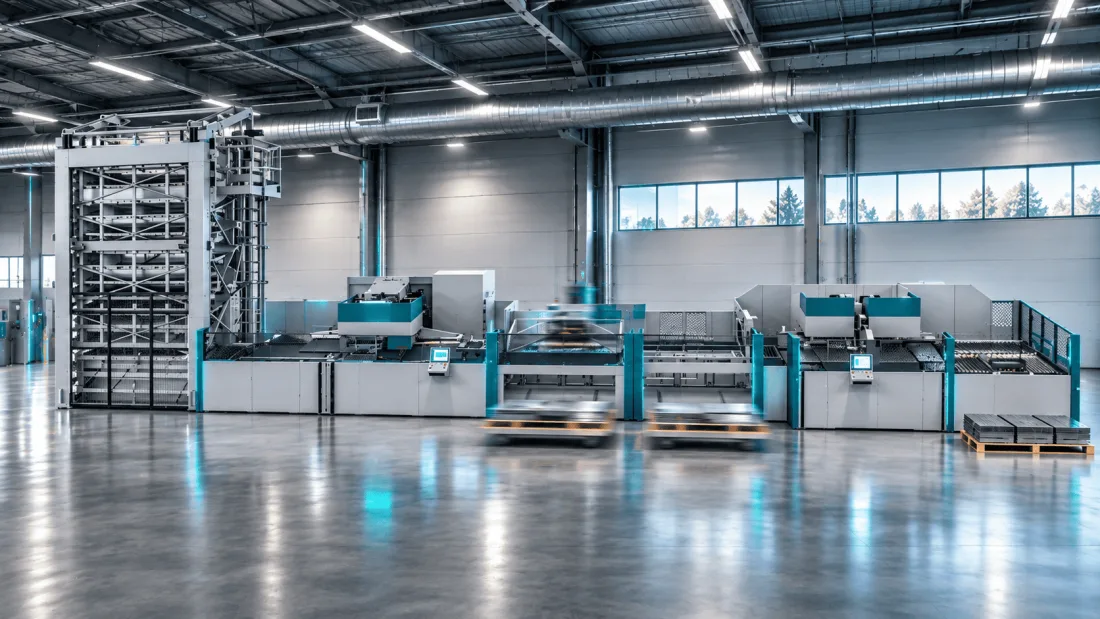
At the production level, automation connects cutting, sorting, bending, storage, and production software. This is where manufacturers gain control over queue time and material traceability, not only machine cycle time. A fast bending cell still underperforms if operators search for blanks, programs are released late, or completed parts are mixed with the wrong order.
Choose Between Robotic Press Brakes and Panel Benders
The central equipment decision is often whether to automate a press brake or route suitable work to a panel bender. Both can be highly productive, but their strengths are different.
Automated press brake cells
A robotic press brake cell retains the versatility of conventional bending technology. It can accommodate a wide range of part forms, bending angles, and tool arrangements, provided the robot can pick, support, and manipulate the workpiece throughout the sequence. Modern cells use offline simulation to confirm reach, collision clearance, gripping points, and cycle time before production begins.
The trade-off is process discipline. Tooling must be standardized, blanks must arrive in predictable condition, and the cell needs reliable part presentation. Complex parts with large changes in center of gravity, narrow gripping surfaces, or significant flexibility may require special end effectors or may not be suitable for unattended handling.
Panel bending systems
Panel benders are designed around speed and repeatability for compatible geometries. They are particularly efficient when a plant produces many enclosure and panel components, because the machine can form multiple bends without the repeated manual rotation and gauging required on a press brake. Automatic tool adjustment also supports mixed production without extensive operator intervention.
The limitation is geometry. Deep box shapes, certain return flanges, specialized forming operations, and workpieces outside the machine’s handling range may still require a press brake. Many high-performing fabrication plants use both technologies: panel bending for repeatable panel work and press brakes for broader job flexibility.
Build Material Flow Around the Bending Cell
Automation is only as reliable as the material flow supporting it. Blanks must arrive in the correct sequence, orientation, and condition. Completed parts must leave the cell without creating a new bottleneck. This is why bending projects should be evaluated as a system rather than a machine purchase.
Start upstream with cutting and blank identification. Laser-cut or punched blanks should be clearly associated with the correct production order and bending program. If protective film, burr direction, or cosmetic surfaces matter, those requirements need to be encoded in the routing and material-handling process. A robot cannot compensate for an incorrect blank or an unplanned grain-direction requirement.
Vertical storage systems can supply material and buffer work between processes while reducing floor-space consumption. In higher-volume applications, automated loading, sorting, and transfer systems can deliver blanks directly to bending. Downstream, stacking stations, conveyors, carts, or assembly buffers should be sized for the actual output rate of the cell.
Do not overlook scrap and rework handling. A cell needs a defined process for rejected blanks, failed inspections, and parts that require manual secondary work. Without one, exceptions gradually become interruptions.
Make Software the Control Layer
Offline programming is one of the most immediate ways to improve bending productivity. Programs can be created from 3D models, checked for tooling and collisions, and released to the shop floor before the blank arrives. This reduces machine-side programming time and gives engineering an opportunity to resolve manufacturability issues earlier.
For automated cells, software must do more than generate bend sequences. It should coordinate robot motion, part orientation, gripper selection, tool configurations, and production priorities. Simulation is essential because it identifies collisions and unreachable bends before they become expensive shop-floor delays.
Production management software connects this technical data to operations. It can prioritize orders, group compatible jobs, monitor machine status, and report actual cycle times, stoppages, and rework. The goal is not to collect data for its own sake. The goal is to identify whether the lost minutes come from loading, programming, tooling, material availability, or unplanned intervention.
Plan Tooling, Quality, and People Together
An automated bending project should include tooling strategy from the beginning. Standardized punch and die sets, repeatable clamping positions, and documented setup conventions reduce variation between jobs. If tools are damaged, misplaced, or inconsistently identified, automation will magnify the problem.
Quality control also needs to move upstream. Angle measurement and automatic correction can compensate for material variation, but they do not replace proper first-off verification or process capability checks. Critical dimensions, cosmetic requirements, and inspection frequencies should be defined for each part family. For demanding work, consider how measurement data will be recorded and how operators will respond when a value moves outside tolerance.
Automation changes operator responsibilities; it does not remove the need for skilled people. Operators become cell supervisors, setup specialists, quality decision-makers, and first-line troubleshooters. Training should cover normal production, changeovers, alarm recovery, safe manual intervention, and basic maintenance. A supplier that can install, train, and support the system after commissioning is a practical risk-control factor, especially when bending is central to delivery performance.
Calculate the Business Case Using Real Available Time
A credible investment case compares current and future output using actual production conditions. Include setup time, material handling, operator attendance, rework, maintenance, and realistic utilization. Comparing only theoretical bend speed will produce an optimistic result that is difficult to achieve on the shop floor.
Look at labor redeployment as well as labor reduction. If a robotic cell allows an experienced brake operator to support programming, quality, or a second machine, the value can be substantial even when headcount does not change. Additional gains may come from shorter lead times, fewer quality escapes, more predictable scheduling, and the ability to run repeat work outside peak staffing hours.
A phased approach is often sensible. Standardize tooling and introduce offline programming first, then automate the highest-volume part families once production data confirms the opportunity. Italian Machinery Association supports this type of equipment and integration assessment across premium bending, automation, storage, and software technologies.
The strongest bending automation projects are not defined by the most sophisticated robot or the fastest stated cycle time. They are defined by a stable flow of suitable parts, reliable process data, trained personnel, and equipment selected for the work the factory intends to win next.